
By Charlene N. Rivera-Bonet | Waisman Science Writer
At a Glance:
- Waisman Center investigator Xinyu Zhao, PhD and collaborator Shaoqin Gong, PhD, were awarded funds from the Eagles Autism Foundation, along with 54 other projects focused on autism research.
- The Zhao lab is working on developing gene-correcting tools to correct a point mutation on the MBD1 gene associated with several symptoms of autism including reduced social interactions, learning deficits, anxiety, defective sensory-motor gating, depression, and abnormal serotonin activity.
- The Gong lab is developing a nanovesicle that would be able to deliver the gene-editing technology to the brain – an approach that could eventually apply to other neurological disorders caused by single‑gene mutations.
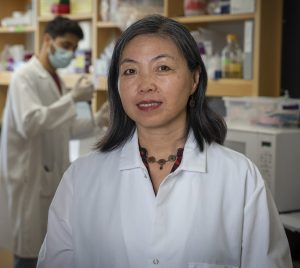
A new research study at the Waisman Center has been funded by the Eagles Autism Foundation to develop a precise, safe, and broadly applicable method for correcting a single-gene mutation associated with symptoms of autism spectrum disorders including learning deficits, anxiety, depression, and reduced social interactions.
Autism is a neurodevelopmental condition that can affect how people interact with others, communicate, learn, and behave. With more than 1,000 genes associated with autism, tailored gene therapy presents the potential to get at the root of some of the symptoms. The challenge, however, is that there is currently no safe and effective way to deliver gene-editing tools to the brain because of the blood-brain barrier—the brain’s own protection mechanism. The proposed research aims to use nanovesicles to deliver gene correction therapy directly to the brain, a methodology with the potential to treat other neurological disorders caused by single-point mutations.
The research is a collaboration between Waisman Center investigator Xinyu Zhao, PhD, Jenni & Kyle Professor and Vilas Distinguished Achievement Professor of Neuroscience, and Shaoqin Gong, PhD, Vilas Distinguished and Advancing Vision Science Chair Professor at UW-Madison.
Single-point mutations occur when a single base pair is added, deleted, or changed in the DNA. A point mutation of the MBD1 gene has been associated with reduced social interactions, learning deficits, anxiety, defective sensory-motor gating, depression, and abnormal serotonin activity – all of which are symptoms frequently associated with autism.
Gene therapy has been used to treat other single-point conditions such as sickle cell anemia. “The single base mutation, if you can correct it, you can treat the condition. But it’s easy to say, very difficult to actually do,” Zhao says.
This is especially true for brain conditions, as the blood-brain barrier, a gatekeeper that prevents toxins from entering the brain, is hard to penetrate, making it hard to deliver the gene editors directly to the brain.
Gong’s lab has been working on ways to deliver gene editors into the brain using nanoparticle encapsulates. “[Gong] has some promising data on the new particle she’s been working on. And we decided to work on this together,” Zhao says.
Zhao’s lab, will continue to work on identifying gene editors that would be the most efficient for correcting the point mutation in the MBD1 gene in mouse models. They will then use Gong’s nanovesicles to deliver these editors to the brain.
“If we can correct that one base– maybe we don’t correct 100% of brain cells, maybe 30%, maybe 20% of brain cells– will we see behavior improvement? And can we correct it in adults, or do we need to correct it earlier in the development? These are questions we can test in the model,” Zhao says. “And this will be our gateway for maybe other diseases, aging diseases, or other types of mutations.”
The Eagles Autism Foundation, founded by the Philadelphia Eagles football team, announced that 54 projects specializing in cutting-edge autism research and care, including Zhao and Gong’s, will receive $10.8 million in funding. Since 2018, the Eagles Autism Foundation has invested more than $40 million to help fund 223 research projects and community grants, adding to the Foundation’s total impact of $50 million raised and counting.
“They are very keen on giving scientists opportunities for something new. So, they take risks,” Zhao says.
The research proposals were assessed by 24 internationally-recognized researchers who were individually selected based on the areas represented in the research proposals. The following criteria were closely considered in weighing the merit of each application: significance, investigator(s), innovation, approach, and environment. All research proposals were evaluated for measurable outcomes and transformational impact in the field of autism.
This is the second time Zhao received funding from the Eagles Autism Foundation. The first funds supported work on better understanding the role of MBD1 in regulating brain development and its relation to autism.